
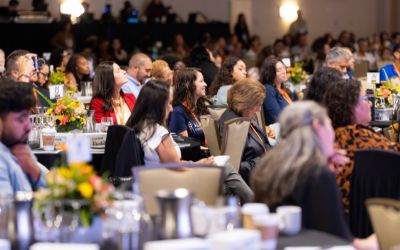
More than 600 leaders from philanthropy, government, nonprofits, business and communities across the Inland Empire gathered August 6 at the Riverside Convention Center for IECF’s 2026 Policy & Philanthropy Summit: All Together.
The day focused on a question that is becoming increasingly important for Riverside and San Bernardino counties: How does a region of nearly 4.8 million people make sure investment, infrastructure and opportunity keep pace with its growth?
Building on IECF’s work with the Vital Conditions, Summit conversations explored housing, local journalism, climate resilience, immigrant support and civic infrastructure, along with the relationships and resources needed to make progress across the region.
Investing in places people want to call home
Rip Rapson, President and CEO of The Kresge Foundation, joined IECF President and CEO Michelle Decker for a main stage conversation about urban policy, civic investment and place-based strategies.
Drawing from lessons learned through Detroit’s revitalization, Rapson encouraged Inland Empire leaders to think about infrastructure at both the regional and neighborhood level.
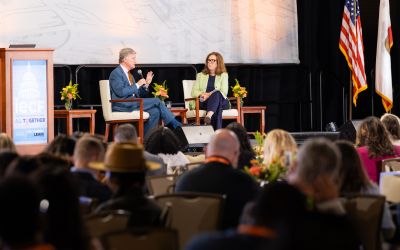
Rip Rapson speaks with Michelle Decker on stage
“There’s a kind of big infrastructure and there’s community infrastructure,” Rapson said. “What are the ways of reducing heat? What are the ways of managing water? What are the ways of creating connectivity between communities?”
That connectivity also extends to how communities approach development and public spaces.
“You can just plop something down. But wouldn’t it be tremendous if you all could figure out a way to make that genuinely connect into the rest of the community and make it a public asset… You want to be in a place that is fun to walk, fun to look around, has things to do. I think that placemaking matters.”
Rapson also spoke about the need to confront historic inequities as communities grow. His remarks reflected a larger question that ran throughout the Summit: As significant public and private investments move through the Inland Empire, who benefits from that growth and who helps shape what it looks like?
Bringing community experience into policy conversations
That question was especially present during “Celebrating Immigrants: Strategies for Belonging in this Moment.”
Luz Gallegos, Executive Director of TODEC Legal Center, spoke about bringing the experiences of farmworkers and immigrant families from the Coachella Valley directly to policymakers, funders and regional leaders.
“Without the women and men who work the land and harvest our food, the world cannot eat and the economy cannot be strong,” Gallegos said.
Federal policy changes were another major focus of the day.
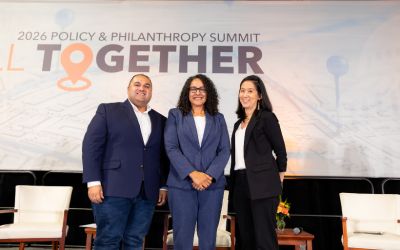
Jesse Melgar, Secretary Kim Johnson, Carolyn Wang Wong
A Summit discussion on H.R. 1, facilitated by IECF Board Chair Jesse Melgar, included California Health & Human Services Secretary Kim Johnson and Carolyn Wang Wong, Chief Strategy Officer at The California Endowment.
Melgar spoke about the importance of trusted community organizations as families navigate changes in federal policy:
“We must work directly with organizations that already hold the trust of our immigrant and Latino communities—delivering information in Spanish and indigenous languages so families have the guidance needed to protect their health.”
Looking toward the Inland Empire’s future
Other Summit sessions addressed climate resilience, housing, community ownership, civic life and the long-term goals the Inland Empire is setting for itself.
Again and again, the conversations pointed to the need for coordination across sectors while keeping the experiences and needs of individual communities at the center of the work.
Congressman Pete Aguilar joined Redlands City Council Member Denise Davis for a conversation about growth and opportunity in the Inland Empire.
“We are a high-growth area, because people want to come here and because you can still achieve the American Dream here in the Inland Empire.”
Aguilar also reflected on opportunities in healthcare and technology and his desire to “ensure every young person has an opportunity to succeed and be a part of the workforce.”
The Summit concluded with “Our North Star: Modeling the Changes to Reach Our Regional Goals,” turning the conversation toward measurable progress and the shared capacity needed to improve quality of life across Riverside and San Bernardino counties.
“The Inland Empire doesn’t lack ideas or leadership,” Decker said. “What this region needs is the level of investment, coordination and attention that matches the scale of what’s already happening here. That’s the work ahead of us, and there are a lot of people ready to do it together.”
The work continues
The conversations from the Summit continue beyond August 6.
IECF will work alongside regional grantees, local government entities and donor partners to turn the day’s policy dialogue into funding initiatives and collaborative programs.
Organizations and residents who want to stay involved are invited to join the IE Vital Conditions Network, where people from across the Inland Empire are working throughout the year on the conditions all people and places need to thrive.
Learn more at ievitalconditionsnetwork.org.
View More Photos Here
IECF is grateful to the Gates Foundation and Randall Lewis, Janell Lewis & The Lewis Group of Companies for their support as Presenting Sponsors, along with Premier Sponsorship from Amazon; U.S. Bank; IEHP/IEHP Foundation; PolicyLink; Kaiser Permanente; Edison International; Yuhaaviatam of San Manuel Nation and the IE Journalism Innovation Hub+ Fund.